



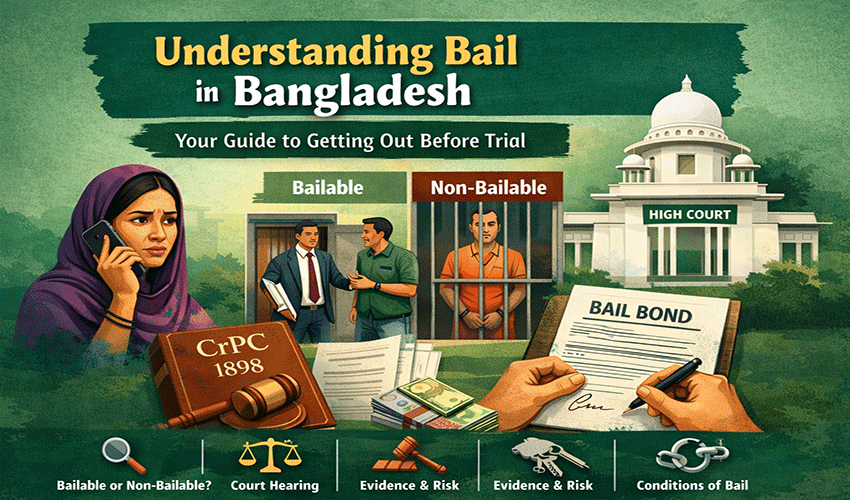
Someone you love just got arrested. The phone call came out of nowhere. Now you’re scrambling to understand what happens next — and whether they can come home before trial.
Here’s the truth: bail in Bangladesh is not one-size-fits-all. Whether someone gets released depends on what they’re accused of, which court hears the application, and how the application is made. Let’s break it down simply.
What Is Bail, Exactly?
Bail is not freedom from the case. It’s a legal promise — backed by money or a surety — that the accused will show up in court whenever required. The basic concept of bail is the release of a person from police custody and delivery into the hands of sureties who undertake to produce the accused before the court whenever required.
Think of it as the court trusting you enough to let you wait for trial at home, rather than behind bars.
The Law That Governs Bail in Bangladesh
The main law is the Code of Criminal Procedure, 1898 (CrPC) — available on the official Bangladesh government legal database at bdlaws.minlaw.gov.bd. Chapter XXXIX of the CrPC 1898 generally governs bail in Bangladesh. Sections 496, 497, 498, and 499 are the main provisions.
There are also special laws for specific offences that override the CrPC in certain cases — but for most criminal matters, these four sections are where everything starts.
Step 1: Is the Offence Bailable or Non-Bailable?
This is the first and most important question. Every criminal offence in Bangladesh is classified in the Second Schedule of the CrPC as either bailable or non-bailable. The category determines everything about how bail works.
Bailable Offences — Bail Is a Right
Section 496 of the Code of Criminal Procedure provides that in the case of bailable offences, the accused has an absolute right to bail, subject to satisfactory sureties being offered if sureties are considered necessary. The provisions of the section are mandatory, and the court or officer in charge of the police station is bound to release the person in custody.
In plain terms: if the charge is bailable, the police station or magistrate must grant bail. They have no choice. In bailable offences, there is no question of discretion in granting bail — the word of the section is imperative.
Examples of bailable offences include minor assault, cheating below a certain threshold, and public nuisance cases.
Non-Bailable Offences — Bail Is a Privilege
In non-bailable offences, bail is never a right — it is sometimes granted in appropriate cases as a privilege.
This is where it gets harder. Murder, rape, robbery, terrorism, and serious drug offences are all non-bailable. The court has discretion. It can say yes or no based on the facts.
The Three Key Bail Sections
Section 496 — Bailable Cases
The accused (or their lawyer) files a bail petition at the police station or the magistrate’s court. In the case of a bailable offence, the court shall grant bail or, instead of taking bail, discharge the accused on his executing a bond without sureties for his appearance.
Once granted, the accused signs a bail bond, the surety signs too, and the magistrate endorses it. The police then release the person.
Section 497 — Non-Bailable Cases
Here, the court weighs the facts carefully. If the person is accused of any non-bailable offence, he might be released on bail — but where it appears that there is reasonable ground for believing the accused is guilty of an offence punishable with death or life imprisonment, he will not be released.
However, the law carves out exceptions. There are provisions for releasing persons accused of non-bailable offences where such a person is under the age of sixteen, is a woman, or is sick or infirm.
Also critically, the courts have held that reasonable grounds cannot be understood solely on the basis that the crime is a non-bailable offence. There must be some grounds in existence to connect the accused person with the crime alleged — an FIR alone is not a sufficient measure for refusing bail.
Section 498 — High Court and Sessions Court Powers
If the magistrate court refuses bail, the accused can go higher. The power of the High Court Division to grant bail is entirely unfettered by conditions, and the limitations guiding courts in granting bail under Section 497 do not apply to it. The jurisdiction of the High Court to grant bail under Section 498 is not merely revisional but concurrent with that of the subordinate magistrate trying the case.
This is also the section used for anticipatory bail — bail sought before an arrest happens, when a person fears they are about to be picked up. After the omission of Section 497A, anticipatory bail has been practised under Section 498.
The Bail Application Process — Step by Step
Here is how it typically unfolds in practice:
Stage 1 — Investigation/Pre-Trial: All bail petitions at this stage go to the Magistrate’s Court. Your lawyer files the petition. The court’s GRO (General Record Officer) puts up the case file. The magistrate hears the petition. If granted, the bail bond is signed and submitted, and the accused is released.
Stage 2 — If the Magistrate Refuses: The petition moves up to the Court of Sessions Judge.
Stage 3 — If Sessions Court Refuses: The petition goes to the High Court Division under Section 498.
Stage 4 — Post-Conviction: A convicted person can apply to the trial court and the High Court Division for bail after the pronouncement of judgment, pending appeal, under Sections 426(2A) and 426(2B) respectively.
What Courts Look At When Deciding Bail
For non-bailable offences, especially, judges consider several factors. Courts in Bangladesh have consistently held that the following matter:
The strength of the evidence. A bare FIR naming someone is not enough to deny bail. There must be credible material linking the accused to the offence.
Flight risk. Will the accused appear when called? Do they have strong local ties — family, property, a permanent address?
Risk of tampering with evidence or witnesses. If there is a real danger that the accused could intimidate victims or destroy evidence, courts will be cautious.
Nature and gravity of the offence. The more serious the allegation, the higher the bar.
Personal circumstances. Age, health, gender, and whether this is a first offence all matter. In the absence of a prima facie case against the accused, there is no legal or moral compulsion to keep someone in detention merely on the allegation that he committed an offence punishable with death or life imprisonment.
When Can Bail Be Cancelled?
Getting bail doesn’t mean it’s guaranteed to last. Bail can be cancelled where the co-accused issued threats to a prosecution witness — such conduct is considered an abuse of the concession of bail. Courts can also cancel bail if the accused violates the conditions of the bond, fails to appear on required dates, or leaves the country without permission.
A Note on Special Laws
For some cases — corruption charges under the Anti-Corruption Commission Act, narcotics cases under the Narcotics Control Act, or cases under the Digital Security Act — there are additional restrictions on bail beyond what the CrPC says. These special statutes can create higher bars or mandatory remand periods. If your case involves any of these laws, specific legal advice is essential.
Practical Tips If Someone You Know Has Been Arrested
Act quickly. The first 24–72 hours matter. An arrested person must be produced before a magistrate within 24 hours of arrest (excluding travel time). This is a constitutional right under Article 33 of the Constitution of Bangladesh.
Hire a lawyer immediately. Bail is not just paperwork — it is an argument. How the petition is framed, what facts are highlighted, and how the court is addressed all affect the outcome.
Gather surety documents. For most bail bonds, a surety (guarantor) is required. This person typically needs to show property ownership or financial standing in the relevant jurisdiction.
Don’t pay unofficial “fees.” Bail processing through proper legal channels has defined costs. Payments to unofficial intermediaries claiming to speed things up are illegal and often counterproductive.
The Bottom Line
Bail law in Bangladesh gives courts significant power — but also sets clear limits on how that power can be used. For bailable offences, release is a legal right that cannot be withheld. For non-bailable offences, a well-prepared application backed by sound legal arguments can still succeed, even in serious cases.
The system is navigable. But it rewards those who understand it.
About the Author